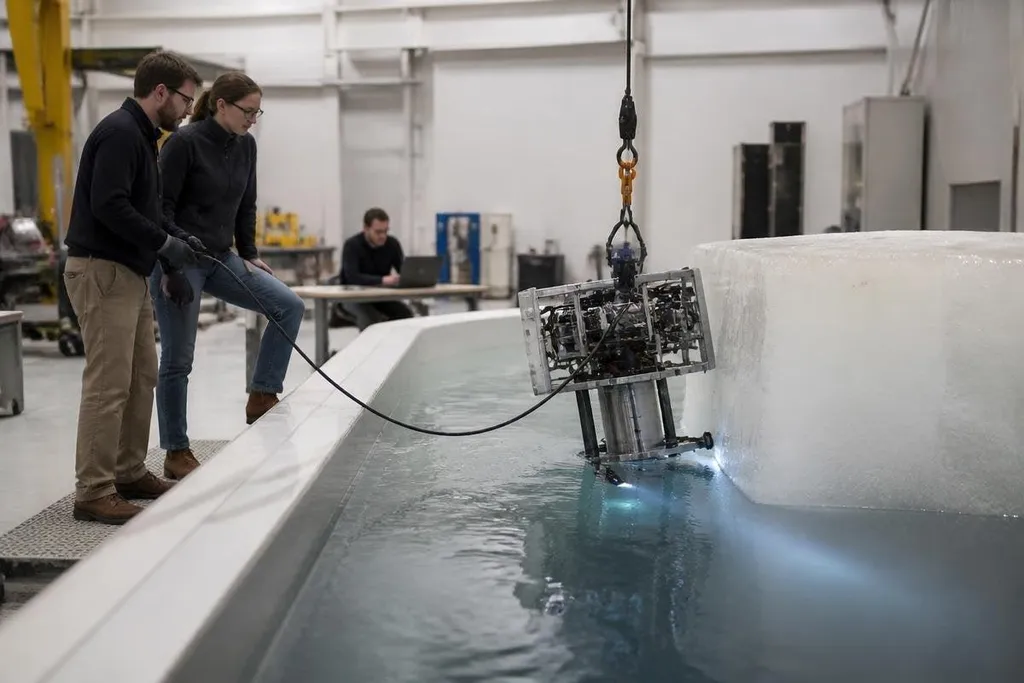
Europa has an ocean beneath an ice shell, but no robot has reached that water. NASA’s Europa Clipper mission will study the moon from orbit after its planned arrival at Jupiter in 2030, giving engineers better data before anyone sends hardware below the ice.
Quick read
- Europa Clipper will make 49 close flybys of Europa.
- An ocean robot would need to pass through ice, work without sunlight, and send data across millions of kilometres.
- The first useful robot may study the surface rather than swim below it.
What we know about Europa
Europa is slightly smaller than Earth’s Moon and circles Jupiter inside a strong radiation field. Its bright surface is made mostly of water ice, with long cracks and ridges that point to movement below.
Scientists have strong evidence for a salty ocean under that ice. The Galileo spacecraft found changes in Europa’s magnetic field that fit a layer of electrically conducting liquid water. The surface also carries chemicals that could matter to life, but no mission has found life there.
That gap matters. A robot could find the right ingredients without finding living cells. It would need to measure the water, its chemistry, and any signs of biological activity with instruments that can separate real samples from material brought from Earth.
Europa Clipper will carry cameras, radar, a magnetometer, and other instruments to study those questions from above. Its radar may show how thick the ice is in some areas, while its spectrometers will check surface materials. The mission won’t drill through Europa.
A robot sent below Europa’s ice would need to drill through it, melt a path, or reach a crack that leads downward. Robotics coverage of Europa missions can help you compare those designs with their power, heat, and communication limits.
How a robot could reach the water
A surface lander would be the more practical first step. It could inspect ice and soil, check local chemistry, and search for material that rose from below through cracks. A Europa lander concept has been studied by NASA, but that concept is not the same as a confirmed flight mission.
Reaching the ocean would need another design. One option is a melt probe that heats its way down through the ice. It could carry a small underwater vehicle, connected by a cable to a surface station. The cable would carry power and data, but it would also face ice movement, sharp surfaces, and great length.
A free-swimming vehicle would avoid the tether, yet it would need its own power, navigation, and communication systems. Radio signals would not pass easily through thick ice, so the vehicle would have to return to a relay point or use another method to send its findings upward.
The robot would also need to work on its own. Jupiter is so far from Earth that a signal takes many minutes to arrive. A person could not steer every turn or rescue a stuck vehicle.
Its control software would need to spot hazards, manage power, and protect samples without waiting for a reply.
The limits are severe
Jupiter’s radiation can damage electronics and sensors. Europa’s surface receives little sunlight, and an underwater robot would have no light source at all. Nuclear power could help, but it adds heat, mass, shielding, and safety work.
Planetary protection sets another limit. A probe from Earth must avoid carrying microbes into Europa’s ocean. Cleaning the hardware is difficult because the robot needs seals, cables, batteries, and moving parts that could trap contamination.
The ice itself may be the largest unknown. If it contains warm pockets, salt, or layers that move at different speeds, a probe could lose contact or stop before reaching the ocean. No current mission has shown that a robot can cross the full ice shell.
I’d treat an under-ice Europa robot as a long-term engineering project, not the next mission after Europa Clipper.
A sensible mission plan
A team judging a Europa robot should check these points before choosing a design:
- Confirm the ice target with radar and gravity data before selecting a landing site.
- Test the drill or melt probe in cold ice with salt and rock mixed through it.
- Give the robot a clear plan for power loss, blocked movement, and broken communications.
- Keep sample handling separate from the spacecraft’s outer surfaces.
- Set the science goal before adding instruments, since mass and power will be limited.
This order keeps the mission tied to facts. Europa Clipper must first show where the ice is thin, what reaches the surface, and which landing sites are safe enough to study.
The ocean may be reachable one day, but the next firm step is still above it: Europa Clipper’s 49 flybys will decide how much of that plan rests on measured terrain rather than estimates.